The November 7 and 9 schedule
NASA scheduled the first ESCAPADE probe’s engine burn for about 09:51 UTC on November 7, or 2:51 p.m. in Pakistan. The second was scheduled for 10:51 UTC on November 9, or 3:51 p.m. in Pakistan. Both times refer to the start of a planned burn near Earth. The burns were expected to last about nine minutes each. This guide uses NASA’s published flight plan. Confirmation of the maneuvers depends on mission updates.
Why the probes came back toward Earth
The two probes launched in November 2025. The launch got them off Earth while the geometry for their trip to Mars was still unfavorable. Instead of taking a direct route, the probes followed a path around the Earth–Sun L2 region and back toward Earth. The detour separated two decisions that usually happen together: when to launch the spacecraft and when to send them toward Mars. NASA’s planned Mars arrivals are in September 2027.
What makes it a powered flyby?
Earth’s gravity bends each probe’s path during the encounter. Firing the engine near closest approach adds speed while the probe is already moving quickly. That timing matters. A burn in the direction of travel adds more orbital energy when the spacecraft is moving faster, for the same change in speed. This is the principle behind the Oberth maneuver. A burn of the same duration farther from Earth would take place under different conditions and would send the spacecraft onto a different trajectory.
What two spacecraft can measure
The probes will study how the solar wind interacts with the magnetic environment around Mars and how that interaction helps particles escape from the atmosphere. Two probes can sample different places at the same time. If one sees a change and the other sees something different, the team can use the paired measurements to investigate whether the change was local. A single probe moving from one point to another has a harder time separating changes over time from differences between places.
Where to check the trajectory
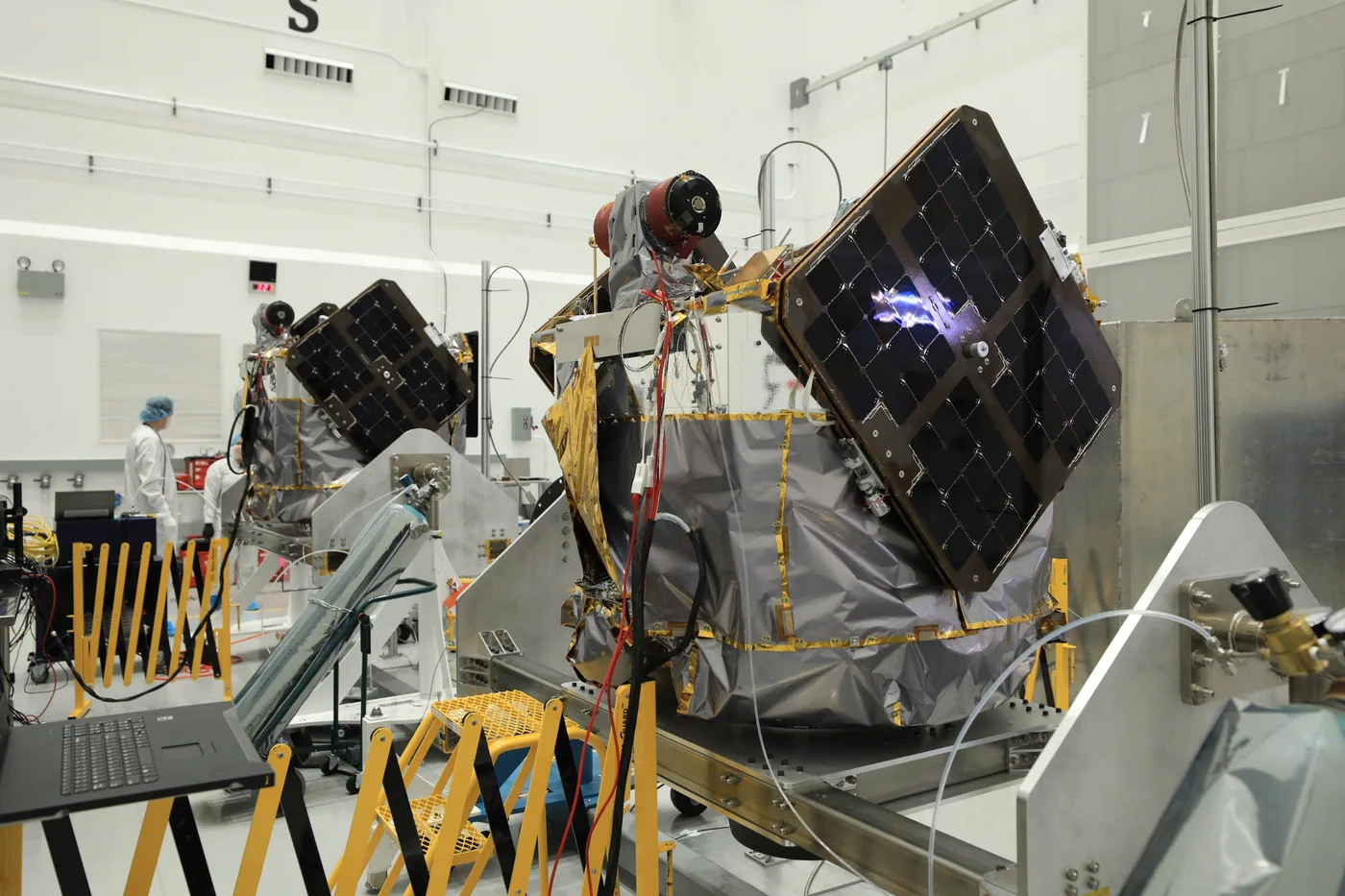
NASA’s Scientific Visualization Studio has a diagram of the route and star charts for selected observing locations. The charts show predicted positions against background stars. Use the chart for the correct date and location, and check NASA’s mission blog for confirmation of the flight events. The photo above shows the spacecraft during ground processing in 2024.