The milestone is still ahead
NASA’s mission-status page places Voyager 1’s one-light-day milestone on November 18, 2026, at about 10:16 UTC: 5:16 a.m. US Eastern Standard Time or 3:16 p.m. Pakistan Standard Time. The probe is approaching that distance as this article is published on November 3. It has not already crossed the marker. NASA gives the distance as approximately 16.1 billion miles, or 25.9 billion kilometres, from Earth.
A light-day measures distance
One light-day is the distance light travels in 24 hours. It is not the spacecraft’s age or a claim that Voyager travelled that far in a day. The mission-status page says Voyager 1 will become the first human-made object to reach this distance from Earth. The Earth reference matters: a distance from the Sun and a distance from Earth are different quantities, even when both are rounded to similar-looking numbers.
Why a reply needs roughly two days
Radio signals travel at the speed of light. At a one-light-day separation, a command takes about 24 hours to arrive and a returning signal takes another 24 hours. Adding those legs gives roughly 48 hours of travel time. Any time needed to schedule, process or carry out the command comes on top of that simple calculation. Think of it as sending a question whose delivery alone takes a day; the spacecraft cannot answer a command before that command reaches it.
October’s silence ended before troubleshooting commands
NASA’s October 29 update reports missed contacts on October 18 and 19. The signal returned on October 20, before troubleshooting commands were sent. Engineers were investigating the cause and had identified an automatic switch to backup thrusters. Restored communication and a completed diagnosis are separate claims: the report established the first while leaving the second open.
Power conservation is another part of the story
NASA also describes a September swap to lower-power devices to prolong science operations, without identifying it as the cause of October’s silence. Meanwhile, NASA’s mission overview identifies Voyager 1 and Voyager 2 as the only spacecraft to have operated beyond the heliosphere, the Sun’s protective bubble of particles and magnetic fields. Voyager 1 reached that boundary in 2012; Voyager 2 followed in 2018. The light-day marker measures distance from Earth rather than entry into interstellar space.
What changes on November 18?
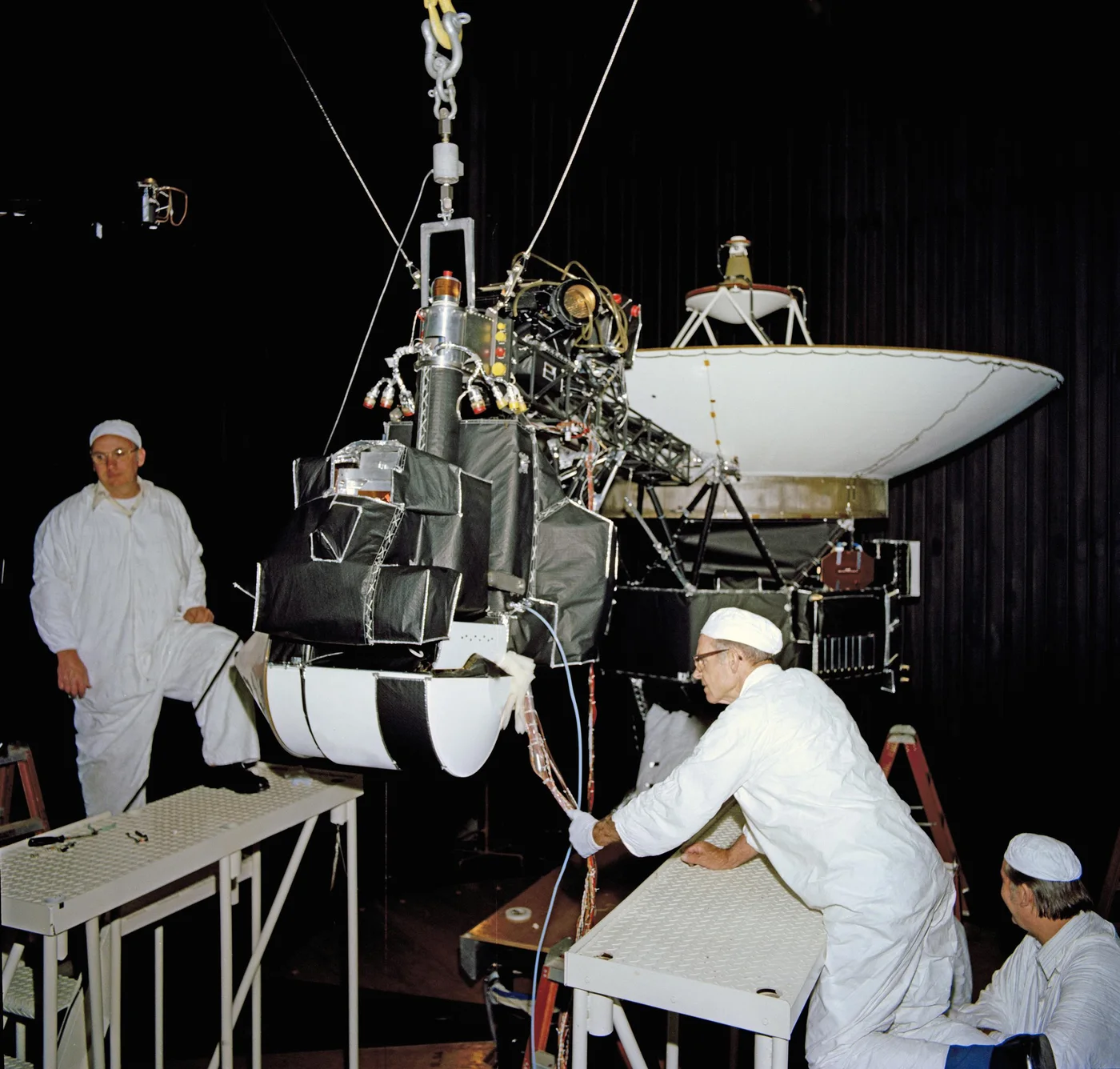
NASA says crossing the light-day distance will not itself change the spacecraft’s environment or trigger a change aboard it. The marker helps explain the scale of the journey and the difficulty of communicating across it. The date above is NASA’s published forecast, not confirmation of a future event. Our photograph is an archival ground-test scene from April 1977, showing one of the Voyager spacecraft with engineers; it is not a recent image from interstellar space.