A real discovery with a classification still to settle
Rubin Observatory announced 2026 ED138 on October 27 as a dwarf-planet candidate beyond Neptune. The object is observed; the uncertainty concerns its physical properties and classification. Calling it a candidate does not mean that astronomers merely guessed it exists. It means that the evidence does not yet settle every claim suggested by a headline about a new dwarf planet. This account was checked October 30 against the observatory’s announcement and the discovery team’s research preprint.
How an October discovery reaches back more than ten years
Matthew Holman identified the object on October 13 while analysing earlier Rubin data. The team then found additional observations, including archival Dark Energy Camera images reaching back to 2016. This is an important distinction between discovery date and observation date: an object can appear in an old image before anyone identifies which moving body the point of light represents. Linking detections across time lets researchers test an orbit against more evidence than a single new photograph provides.
Why the size estimate has such a wide range
The team’s October 28 preprint estimates a diameter of 612–1,530 kilometres for assumed surface reflectivities between 0.25 and 0.04. These are alternative assumptions, not two measured edges of a directly photographed surface. A bright object can be relatively small and reflective, or larger and darker. Brightness alone therefore leaves room for different sizes. The paper was submitted to The Astronomical Journal; the arXiv page presents a preprint, not evidence that journal peer review has been completed.
Distance and orbit answer different questions
Rubin’s announcement places ED138 at about 46 astronomical units from the Sun at the time described. One astronomical unit is the average Earth–Sun distance. The preprint gives a semimajor axis of 43.09 astronomical units and an orbital inclination of about 24.4 degrees. The current distance and semimajor axis need not match: one describes a location along the orbit, while the other describes the orbit’s overall scale. Neither number is a physical diameter. Keeping those quantities separate avoids turning several different measurements into contradictory claims.
What would strengthen the classification?
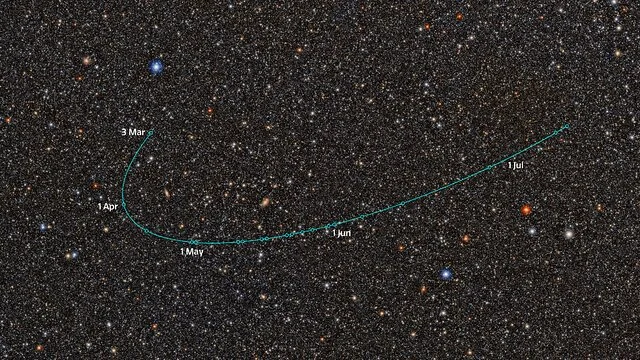
The observatory says infrared observations are needed to constrain the size and establish the object’s nature more firmly. For now, dwarf-planet candidate is the accurate description. There is no confirmed new planet count in this announcement. Future coverage should identify which measurement changed rather than treat every follow-up as a fresh discovery. The accompanying official image shows an annotated orbital track against a star field; it is not a close-up photograph showing the object’s surface or shape.