What did the new assessment find?
NASA and NOAA’s November 4 assessment ranks the 2026 Antarctic ozone hole seventh largest by seasonal average area in 48 years of monitoring. NASA’s Earth Observatory revisited the findings on November 9. The agencies still describe long-term recovery as on track. Those statements answer different questions. A seasonal ranking describes this year’s atmospheric conditions, while recovery concerns the effects of declining ozone-depleting chemicals over decades.
Three numbers that measure different things
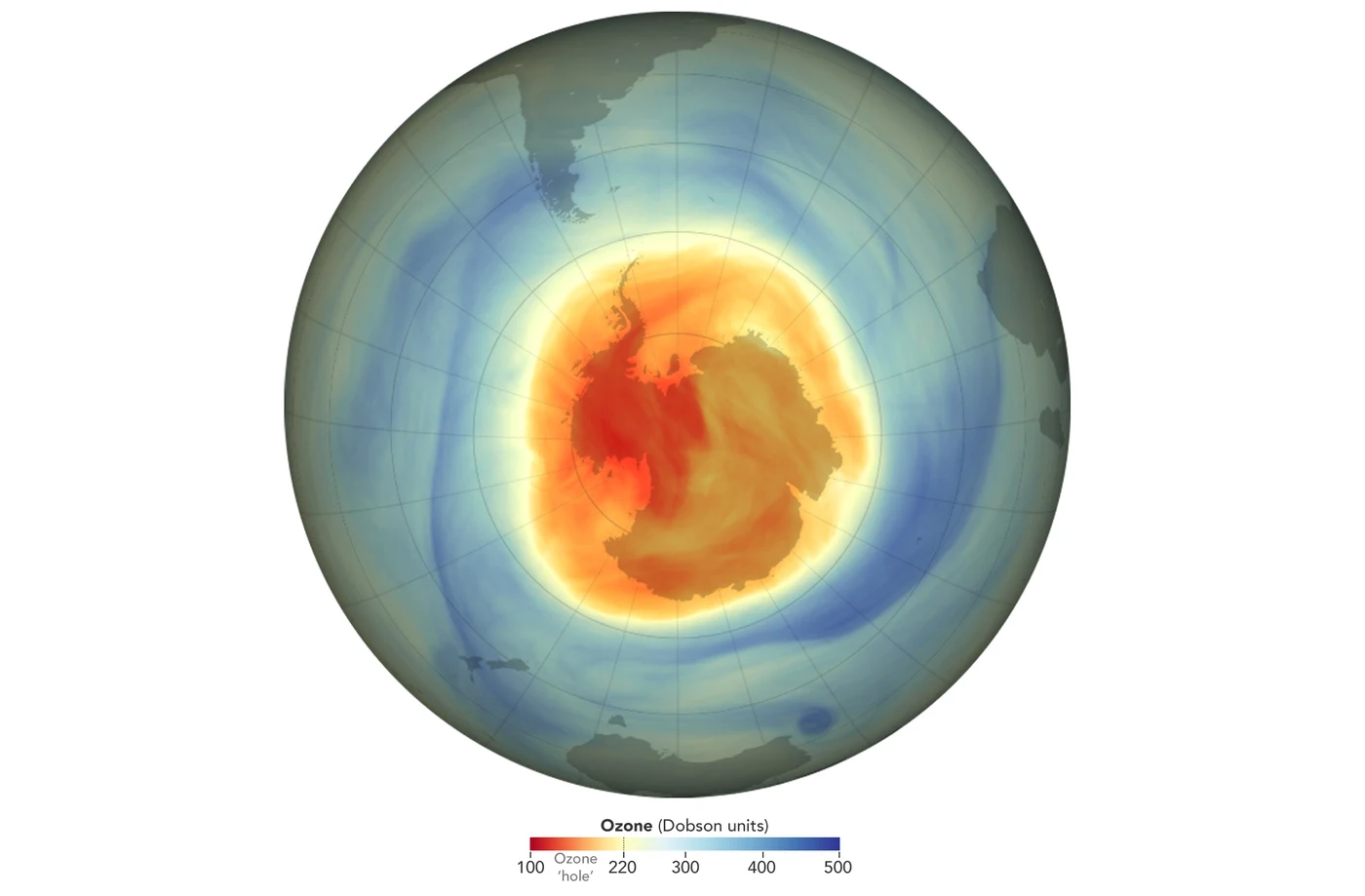
The average area was about 25 million square kilometers during September 7–October 13. The largest daily area was 27.1 million square kilometers on September 18. Separately, instruments above the South Pole recorded a minimum ozone column of 105 Dobson units on October 17. The first two numbers describe geographical extent over different time windows. The third describes the amount of ozone above one location. They should not be treated as interchangeable scores of damage.
How to read the map
NASA defines the ozone hole using a threshold of 220 Dobson units. The colored area represents depleted ozone in the atmosphere above Antarctica, rather than a literal opening with no ozone left. On the visualization, red and orange indicate lower ozone amounts and blue indicates higher amounts. The legend is essential to reading it. The map depicts September 18, the day of maximum area, rather than the state of the atmosphere on this article’s publication date. A striking map can communicate location well, but its date and measurement still determine what it can support.
Why did the hole grow this year?
The agencies identify an unusually strong Antarctic polar vortex. This circulation helps keep stratospheric air cold enough for clouds that enable chlorine and bromine chemistry to destroy ozone. NOAA explains that unusually weak atmospheric wave activity in August and September helped the vortex persist over a wider area. Weather therefore changed the conditions in which existing ozone-depleting chemicals acted. It did not replace those chemicals as the underlying driver of ozone destruction.
What would count as evidence about recovery?
The Montreal Protocol controls ozone-depleting substances, but legacy compounds remain in the atmosphere and old equipment for many years. NASA and NOAA say the 2026 hole would have been larger with the higher chemical burden of earlier decades. This is why a difficult season can coexist with progress from those controls. To judge the trend, compare consistent measurements across many years and examine the chemical burden as well as weather. One large year cannot establish that recovery has failed, and one small year cannot establish that recovery is complete.
Ozone protection and air pollution require different readings
Stratospheric ozone helps protect life from ultraviolet radiation. Ozone near the ground is an air pollutant. An Antarctic stratospheric map does not tell you the ground-level ozone concentration in your city. For local air-quality decisions, use the pollutant, station and timestamp in the relevant monitoring report. For the Antarctic season, NASA Ozone Watch provides updated observations. Keep those two monitoring tasks separate when interpreting a headline or sharing a map.